Come, Follow Me / 2026 / week 44
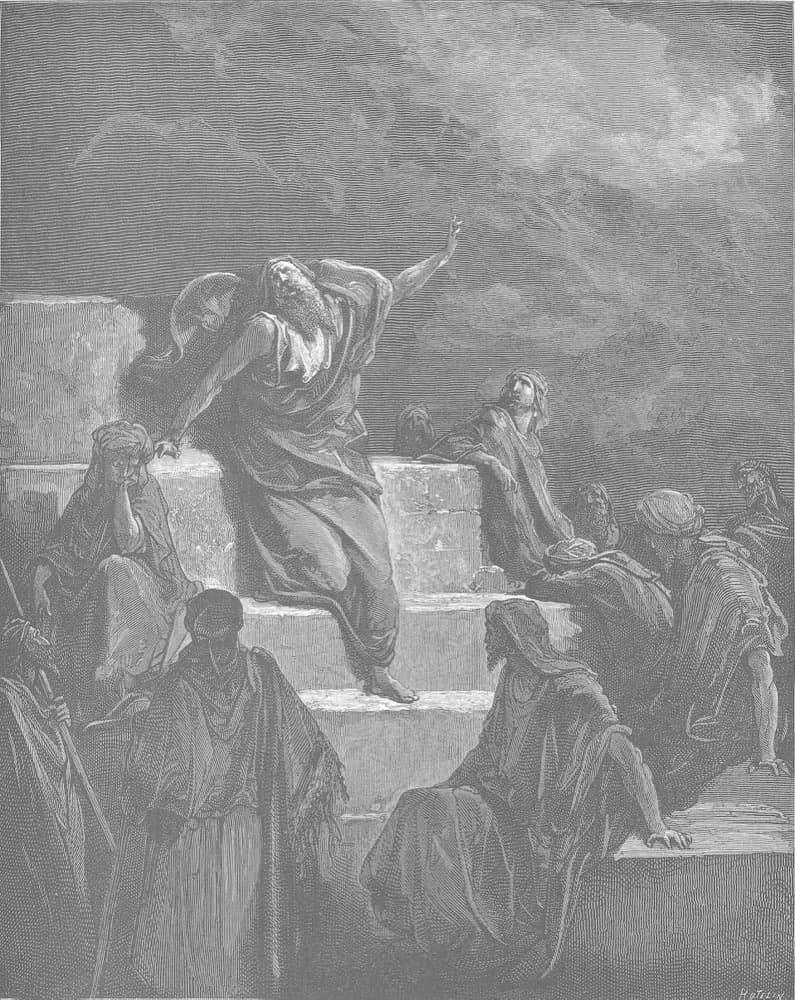
The Prophet Jeremiah
Week 44 of 52
study guideJeremiah 31–33; 36–39; Lamentations 1; 3
October 26–November 1, 2026
The new covenant, written on hearts rather than on stone — announced in the middle of the siege that ended the old arrangement.
The big idea
In the middle of the siege that ended the old arrangement, God promised a new covenant — written not on stone but on the heart.
Step 1 · Get your bearings
Before you read
Who is speaking, to whom, and what was happening to them.
- When
- c. 588–586 BC, the final siege and fall of Jerusalem. Lamentations was written in its aftermath.
- Where
- Inside the besieged city — much of it from Jeremiah's prison in the court of the guard.
- Who
- King Zedekiah, the last king of Judah; his officials; Baruch the scribe; and a starving city.
What was happening
Babylon's army surrounded Jerusalem. Jeremiah had been arrested for predicting its fall, and he was right: in 586 BC the walls were breached, the temple burned, and Zedekiah's sons were killed in front of him. These chapters hold the darkest events in the Old Testament and some of its most hopeful promises, side by side.
Step 2 · See the whole
The shape of the week
Chapters 30–33 are sometimes called the Book of Consolation. They were spoken while the city was falling, which is what gives them their force. In 31 God promises a new covenant; in 32 He tells Jeremiah — in prison, with the enemy at the walls — to buy a field, because “houses and fields and vineyards shall be possessed again in this land.” Hope is expressed as a land deed.
Chapters 36–39 are narrative. King Jehoiakim cuts Jeremiah's scroll apart column by column and throws it in the fire; God has Jeremiah dictate it again, with more added. Jeremiah is lowered into a muddy cistern and left to die, and a foreign servant, Ebed-melech, pulls him out. Then the city falls.
Lamentations is five poems of grief over Jerusalem, most of them acrostics — each verse beginning with the next letter of the Hebrew alphabet, as though grief were being given an order it could not have on its own. In chapter 3, the central poem of the five, the poet stops and remembers that God's mercies are new every morning.
Step 3 · Read
Day by day
The block in seven readings, each with one thing to look for. Tick a day off when you have read it.
MonOct 26
Read verses 31–34 slowly. Where will the new covenant be written, and what will no longer need to be taught?
TueOct 27
Why would God tell Jeremiah to buy land in a city about to be conquered? Look at verses 15 and 17.
Step 4 · Go slowly
Key passages
The verses the week turns on — what they meant to the people who first heard them, and what they mean for you. Tap any verse to mark it.
1Passage 1 of 4
Written in their hearts
Jeremiah 31:31–34ot 31Behold, the days come, saith the Lord, that I will make a new covenant with the house of Israel, and with the house of Judah:
32Not according to the covenant that I made with their fathers in the day that I took them by the hand to bring them out of the land of Egypt; which my covenant they brake, although I was an husband unto them, saith the Lord:
33But this shall be the covenant that I will make with the house of Israel; After those days, saith the Lord, I will put my law in their inward parts, and write it in their hearts; and will be their God, and they shall be my people.
34And they shall teach no more every man his neighbour, and every man his brother, saying, Know the Lord: for they shall all know me, from the least of them unto the greatest of them, saith the Lord: for I will forgive their iniquity, and I will remember their sin no more.
What it meant then
The covenant at Sinai was written on tablets of stone, and Israel had broken it. God does not lower the standard — He promises to move it: the law will be written inside them. Knowing the Lord will not depend on being taught by someone else, because everyone will know Him.
What it means now
Hebrews quotes this passage in full as the promise Christ fulfilled (Hebrews 8:6–13). The covenants we make are meant to become part of who we are, not rules we consult from the outside.
In the original Hebrew
Ask yourself
Which of your covenants is still written on stone for you — and which have moved into your heart?
2Passage 2 of 4
Buy my field
Jeremiah 32:6–9, 15, 17ot 6And Jeremiah said, The word of the Lord came unto me, saying,
7Behold, Hanameel the son of Shallum thine uncle shall come unto thee, saying, Buy thee my field that is in Anathoth: for the right of redemption is thine to buy it.
8So Hanameel mine uncle’s son came to me in the court of the prison according to the word of the Lord, and said unto me, Buy my field, I pray thee, that is in Anathoth, which is in the country of Benjamin: for the right of inheritance is thine, and the redemption is thine; buy it for thyself. Then I knew that this was the word of the Lord.
9And I bought the field of Hanameel my uncle’s son, that was in Anathoth, and weighed him the money, even seventeen shekels of silver.
15For thus saith the Lord of hosts, the God of Israel; Houses and fields and vineyards shall be possessed again in this land.
17Ah Lord God! behold, thou hast made the heaven and the earth by thy great power and stretched out arm, and there is nothing too hard for thee:
What it meant then
Jeremiah is in prison and the Babylonian army is at the walls. His cousin offers to sell him family land at Anathoth — land the enemy already controls. God tells him to buy it, sign the deed before witnesses and seal it in a clay jar to keep for a long time.
What it means now
It is the most practical act of faith in the book: putting money on a future nobody else could see. Faith is not only believing that God will restore; sometimes it is acting now as if He already has.
Ask yourself
What “field” could you buy this week — a concrete act that shows you believe God's promises about your future?
3Passage 3 of 4
The scroll in the fire
Jeremiah 36:23, 27–28, 32ot 23And it came to pass, that when Jehudi had read three or four leaves, he cut it with the penknife, and cast it into the fire that was on the hearth, until all the roll was consumed in the fire that was on the hearth.
27Then the word of the Lord came to Jeremiah, after that the king had burned the roll, and the words which Baruch wrote at the mouth of Jeremiah, saying,
28Take thee again another roll, and write in it all the former words that were in the first roll, which Jehoiakim the king of Judah hath burned.
32Then took Jeremiah another roll, and gave it to Baruch the scribe, the son of Neriah; who wrote therein from the mouth of Jeremiah all the words of the book which Jehoiakim king of Judah had burned in the fire: and there were added besides unto them many like words.
What it meant then
As each few columns were read to him, King Jehoiakim cut them off with a penknife and threw them in the fire until the whole scroll was gone. God's answer was simply to have it written again — with many more words added.
What it means now
When 116 pages of the Book of Mormon translation were lost, the Lord told Joseph Smith that His work cannot be frustrated (D&C 3:1; 10:38–45). People can destroy a copy of God's word. They cannot stop it.
Ask yourself
Is there counsel from God you have tried to cut up and burn? What happened to it?
4Passage 4 of 4
New every morning
Lamentations 3:21–26ot 21This I recall to my mind, therefore have I hope.
22It is of the Lord’s mercies that we are not consumed, because his compassions fail not.
23They are new every morning: great is thy faithfulness.
24The Lord is my portion, saith my soul; therefore will I hope in him.
25The Lord is good unto them that wait for him, to the soul that seeketh him.
26It is good that a man should both hope and quietly wait for the salvation of the Lord.
What it meant then
The poet has just described God as a bear lying in wait and an archer aiming at him. Then, near the centre of the book, he stops and deliberately calls something else to mind: the Lord's mercies have not run out.
What it means now
Hope here is an act of memory, not a feeling that arrives. The poet chooses what to recall. Morning is the unit of mercy — enough for today, renewed tomorrow.
In the original Hebrew
Ask yourself
When everything feels dark, what do you deliberately call to mind?
Every page points to Him
Look for Christ
“They are they which testify of me” (John 5:39). Where this week's reading does.
Mediator of the new covenant
Hebrews quotes Jeremiah 31:31–34 in full and calls Jesus “the mediator of a better covenant.” At the Last Supper He took the cup and called it “the new testament in my blood” — Jeremiah's phrase, spoken over the sacrament.
Rachel weeping
Jeremiah 31:15 pictures Rachel weeping for her children. Matthew applies it to the grief at Bethlehem when Herod killed the infants — but Jeremiah's next verse says, “Refrain thy voice from weeping… they shall come again.”
Lifted out of the pit
Jeremiah sank into the mire of a cistern and was drawn out by ropes. The image of being lifted from the pit runs through the Psalms and points to the One who descended below all things so that no one would be left there.
Latter-day light
What the Restoration adds
What the Book of Mormon, the Doctrine and Covenants, the Pearl of Great Price and the Joseph Smith Translation bring to this block.
Mulek survived
Jeremiah 39 records that Zedekiah's sons were killed before his eyes. The Book of Mormon adds that one son, Mulek, escaped — and was brought to the Americas, where his descendants founded Zarahemla. The Bible's account of the fall of Jerusalem has a sequel on another continent.
God's work cannot be frustrated
Jehoiakim burned a scroll and God had it rewritten with more. When Martin Harris lost the first 116 manuscript pages, the Lord told Joseph Smith the same thing in plainer words, and had already prepared the small plates of Nephi to replace them.
Jeremiah 36:27–32 · D&C 3:1–3 · D&C 10:38–45 · Words of Mormon 1:6–7
The new covenant
The Lord calls the Book of Mormon “the new covenant” in D&C 84:57, and the everlasting covenant restored in these days is the fulfilment of the promise that God's law would be written in hearts.
What to carry out of the week
Principles to live
- 1
God wants His law written in our hearts, not only on stone.
- 2
Faith sometimes means acting now on a future no one else can see.
- 3
Nothing is too hard for the Lord.
- 4
God's word can be destroyed in a copy, but never stopped.
- 5
Hope is an act of memory — choosing to recall God's faithfulness.
Make it yours
Ponder and record
Pick one question. Write what comes — a sentence is enough.
- 01God says under the new covenant no one will need to say “Know the Lord,” because all will know Him (31:34). How do you know the Lord — personally, not secondhand?
- 02Jeremiah 33:3 says, “Call unto me, and I will answer thee.” What would you call to Him about this week?
- 03Ebed-melech was a foreigner who risked himself to save a prophet (38:7–13). God later promised to protect him (39:15–18). Who has pulled you out of a pit?
- 04Lamentations gives grief an order — letter by letter. How might writing your sorrows down help you process them?
- 05Which do you find easier to believe: that God is just, or that His mercies are new every morning?
Kept on this device, and collected in your notebook with everything else.
Teaching it
At home or in class
Simple ways to study this week together.
- Idea 1Write a family “deed” for something you hope for in the future, sign it, and seal it in a jar, like Jeremiah's field (32:14).
- Idea 2Read Lamentations 3:22–23 each morning this week at breakfast and name one mercy from the day before.
- Idea 3Tie soft rags to a rope and act out Ebed-melech's rescue (38:11–13). Talk about why he thought to pad the ropes.
Keep going
More in this library
Full lessons, topics and word studies that bear on this week's block.
Doctrinal topics
The doctrine this block raises, followed wherever it goes in the canon.
Reference chains
Passages in a deliberate order, each step earning the next.
Hebrew & Greek
The words underneath the English, where the translation cost something.
Sources
- Come, Follow Me — For Home and Church: Old Testament 2026
- Old Testament Student Manual: 1 Kings–Malachi — Church Educational System, on Jeremiah 30–52 and Lamentations
- Bible Dictionary, “Lamentations”
- Brown, Driver and Briggs, A Hebrew and English Lexicon of the Old Testament — s.v. ברית, לב, חסד, אמונה
Scripture text is the Church’s edition of the King James Version, fetched from the Gospel Library rather than retyped.