Come, Follow Me / 2026 / week 43
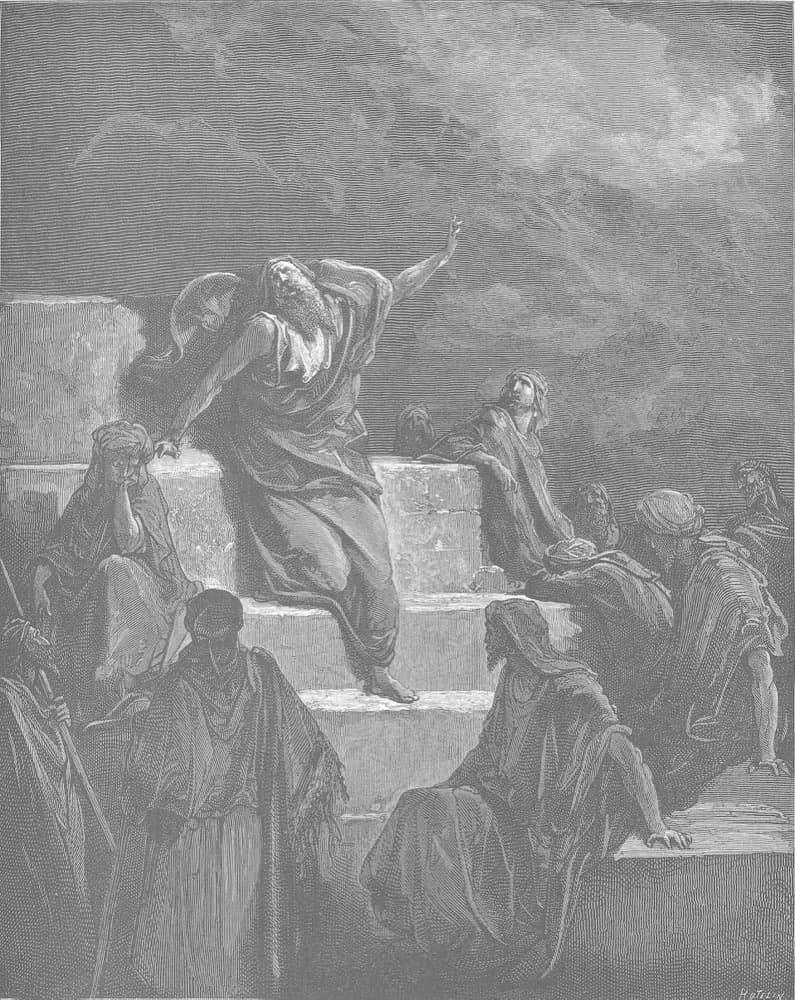
The Prophet Jeremiah
Week 43 of 52
this weekstudy guideJeremiah 1–3; 7; 16–18; 20
October 19–25, 2026
“Before I formed thee in the belly I knew thee” — two verbs, both prior to birth, and the second is hard to explain as foreknowledge alone.
The big idea
God knew Jeremiah before he was born and called him to a message so hard it burned in his bones when he tried to keep quiet.
Step 1 · Get your bearings
Before you read
Who is speaking, to whom, and what was happening to them.
- When
- Called c. 627 BC, in the thirteenth year of King Josiah (1:2), and prophesied for about forty years — through the fall of Jerusalem in 586 BC.
- Where
- Jerusalem and its temple. Jeremiah came from Anathoth, a village of priests a few miles north (1:1).
- Who
- A nation convinced the temple would protect it however it lived — the same Jerusalem Lehi warned, and left.
What was happening
Babylon was rising in the east. Jeremiah's message was that Jerusalem would fall, and that God would still gather His people afterwards. For saying so he was mocked, beaten, put in the stocks and imprisoned. He was also Lehi's contemporary — the Book of Mormon names him.
Step 2 · See the whole
The shape of the week
Jeremiah is the most personal book of the prophets. We see his call, his objections, his loneliness and his arguments with God, often in his own words. He was called young, protested that he was only a child, and spent the rest of his life delivering a message nobody wanted to hear.
This week's chapters move through five scenes: the call (1); Israel's unfaithfulness, pictured as a spouse who has walked away, and God pleading for her to come back (2–3); the temple sermon, where Jeremiah tells worshippers at the gate that the building will not save them (7); a promise of future gathering hidden inside a chapter of judgement (16); and Jeremiah's lament after a night in the stocks (20).
Keep Lehi in view as you read. He was one of the “many prophets” preaching in Jerusalem in those years (1 Nephi 1:4), the brass plates carried “many prophecies… by the mouth of Jeremiah” (1 Nephi 5:13), and Nephi mentions that Jeremiah had been thrown into prison (1 Nephi 7:14). Lehi's family left the very city these chapters were preached to.
Step 3 · Read
Day by day
The block in seven readings, each with one thing to look for. Tick a day off when you have read it.
MonOct 19
What three things does God say He did before Jeremiah was born (verse 5)? What did Jeremiah say back?
TueOct 20
Verse 13 names two evils. What are they — and what is wrong with a broken cistern?
ThuOct 22
What did the people keep repeating about the temple (verse 4)? Why was it not enough?
FriOct 23
In a chapter of judgement, verses 14–16 promise something surprising. What is it?
SatOct 24
17:7–8 describes a tree; 18:1–6 a potter. What does each say about trusting God?
SunOct 25
Jeremiah complains bitterly in verses 7–8. What happens in verse 9 when he tries to stop?
Step 4 · Go slowly
Key passages
The verses the week turns on — what they meant to the people who first heard them, and what they mean for you. Tap any verse to mark it.
1Passage 1 of 5
Before I formed thee
Jeremiah 1:4–10ot 4Then the word of the Lord came unto me, saying,
5Before I formed thee in the belly I knew thee; and before thou camest forth out of the womb I sanctified thee, and I ordained thee a prophet unto the nations.
6Then said I, Ah, Lord God! behold, I cannot speak: for I am a child.
7But the Lord said unto me, Say not, I am a child: for thou shalt go to all that I shall send thee, and whatsoever I command thee thou shalt speak.
8Be not afraid of their faces: for I am with thee to deliver thee, saith the Lord.
9Then the Lord put forth his hand, and touched my mouth. And the Lord said unto me, Behold, I have put my words in thy mouth.
10See, I have this day set thee over the nations and over the kingdoms, to root out, and to pull down, and to destroy, and to throw down, to build, and to plant.
What it meant then
God tells a young man from a priestly family that his calling came before his birth. Jeremiah protests that he is only a child. God does not argue about his age — He touches his mouth and gives him six verbs: four to tear down, two to build up.
What it means now
Restoration scripture reads this as foreordination. Abraham saw noble spirits chosen before the world was (Abraham 3:22–23), and Alma says priests were called “from the foundation of the world” (Alma 13:3). A foreordained calling is still a calling — it has to be accepted and lived.
In the original Hebrew
King James renders it “I knew thee”
Yādaʿ is knowing by experience and relationship, not merely by information — it is the word used for the closeness of marriage (Genesis 4:1). To be known before birth, in this sense, is to have been in relationship with God before birth.
Full lexicon entry →
Ask yourself
If God knew you before you were born, what might He have known you would be capable of?
2Passage 2 of 5
The fountain of living waters
Jeremiah 2:11–13ot 11Hath a nation changed their gods, which are yet no gods? but my people have changed their glory for that which doth not profit.
12Be astonished, O ye heavens, at this, and be horribly afraid, be ye very desolate, saith the Lord.
13For my people have committed two evils; they have forsaken me the fountain of living waters, and hewed them out cisterns, broken cisterns, that can hold no water.
What it meant then
A spring flows on its own, fresh and moving. A cistern is a pit cut into rock and plastered to hold rainwater — it has to be dug, filled and kept, the water goes stale, and a cracked one loses everything. Israel traded the first for the second.
What it means now
Jesus offered the Samaritan woman “living water” that would become “a well of water springing up into everlasting life” (John 4:10–14). We still hew out cisterns: things we build to hold what only God can supply.
In the original Hebrew
King James renders it “living waters”
“Living water” is a technical term: water that flows from a spring or stream rather than standing in a vessel. The law of Moses required it for purification (Leviticus 14:5). God calls Himself the source of that kind of water — the kind that cleanses.
Full lexicon entry →
Ask yourself
What cistern do you keep digging to hold something only the Lord can give?
3Passage 3 of 5
Return, ye backsliding children
Jeremiah 3:12–14, 22ot 12Go and proclaim these words toward the north, and say, Return, thou backsliding Israel, saith the Lord; and I will not cause mine anger to fall upon you: for I am merciful, saith the Lord, and I will not keep anger for ever.
13Only acknowledge thine iniquity, that thou hast transgressed against the Lord thy God, and hast scattered thy ways to the strangers under every green tree, and ye have not obeyed my voice, saith the Lord.
14Turn, O backsliding children, saith the Lord; for I am married unto you: and I will take you one of a city, and two of a family, and I will bring you to Zion:
22Return, ye backsliding children, and I will heal your backslidings. Behold, we come unto thee; for thou art the Lord our God.
What it meant then
After describing Israel's unfaithfulness in the harshest terms in scripture, God does not close the door. He pleads: come back, and I will heal you. His anger, He says, is not for ever.
What it means now
The Old Testament's word for repentance is this word — turn, return. The invitation is not “fix yourself first” but “come back,” and the healing is His to do.
In the original Hebrew
King James renders it “Return, ye backsliding children”
Verse 22 is a play on one root: “turn back, you who have turned away, and I will heal your turnings.” The same motion that took them away brings them home. Repentance is not a new direction invented from nothing; it is a turn.
Full lexicon entry →
Ask yourself
What does “return” ask of you that “improve” does not?
4Passage 4 of 5
The temple of the LORD
Jeremiah 7:3–4, 8–11ot 3Thus saith the Lord of hosts, the God of Israel, Amend your ways and your doings, and I will cause you to dwell in this place.
4Trust ye not in lying words, saying, The temple of the Lord, The temple of the Lord, The temple of the Lord, are these.
8Behold, ye trust in lying words, that cannot profit.
9Will ye steal, murder, and commit adultery, and swear falsely, and burn incense unto Baal, and walk after other gods whom ye know not;
10And come and stand before me in this house, which is called by my name, and say, We are delivered to do all these abominations?
11Is this house, which is called by my name, become a den of robbers in your eyes? Behold, even I have seen it, saith the Lord.
What it meant then
Standing in the temple gate, Jeremiah tells the crowd that chanting “the temple of the Lord” will not save them if they steal, kill and then come to stand in God's house as if nothing had happened. Is this house, he asks, a hideout for robbers?
What it means now
Jesus quoted verse 11 when He cleansed the temple (Matthew 21:13). Sacred places and ordinances are gifts, but they do not protect people who will not let them change their lives.
Ask yourself
What sacred thing might you be trusting in without letting it change you?
5Passage 5 of 5
A burning fire shut up in my bones
Jeremiah 20:7–9ot 7O Lord, thou hast deceived me, and I was deceived: thou art stronger than I, and hast prevailed: I am in derision daily, every one mocketh me.
8For since I spake, I cried out, I cried violence and spoil; because the word of the Lord was made a reproach unto me, and a derision, daily.
9Then I said, I will not make mention of him, nor speak any more in his name. But his word was in mine heart as a burning fire shut up in my bones, and I was weary with forbearing, and I could not stay.
What it meant then
After a night in the stocks (20:2), Jeremiah complains that God has overpowered him and that he is mocked all day long. He decides to stop speaking. He cannot: the word burns in him until it comes out.
What it means now
Scripture does not hide prophets' struggles. Nephi cried “O wretched man that I am” (2 Nephi 4:17), and Joseph Smith prayed “O God, where art thou?” from Liberty Jail (D&C 121:1). Faith and complaint can live in the same person.
Ask yourself
Is there something true you know that you have been trying to keep quiet about?
Every page points to Him
Look for Christ
“They are they which testify of me” (John 5:39). Where this week's reading does.
Living water
Jeremiah twice calls the Lord “the fountain of living waters.” Jesus took the image as His own — to the woman at the well, and at the Feast of Tabernacles: “If any man thirst, let him come unto me, and drink.”
Jeremiah 2:13 · Jeremiah 17:13 · John 4:10–14 · John 7:37–39
“A den of robbers”
When Jesus drove the money-changers out of the temple, He quoted Jeremiah 7:11. He was standing where Jeremiah had stood, saying what Jeremiah had said, about the same kind of trust in a building.
Some said He was Jeremiah
When Jesus asked who people thought He was, one answer was Jeremiah. Both were rejected by their own home towns — Anathoth plotted against Jeremiah, and Nazareth tried to throw Jesus off a cliff — and both wept over Jerusalem.
Matthew 16:13–14 · Jeremiah 11:21 · Luke 4:28–29 · Luke 19:41
Latter-day light
What the Restoration adds
What the Book of Mormon, the Doctrine and Covenants, the Pearl of Great Price and the Joseph Smith Translation bring to this block.
Lehi and Jeremiah, in the same city
The Book of Mormon opens in Jeremiah's Jerusalem. Lehi preached the same message, met the same response, and was commanded to leave. Nephi records that Jeremiah had been cast into prison — a detail that places the two prophets in the same streets in the same years.
Chosen before birth
Jeremiah 1:5 is the Old Testament's clearest statement of what Restoration scripture calls foreordination. Abraham saw the noble and great ones chosen before they were born, and Joseph F. Smith saw prophets of the latter days among them.
Fishers and hunters
Jeremiah 16 promises a gathering so great it will eclipse the exodus from Egypt. Moses restored the keys of that gathering in the Kirtland Temple, and missionary work is how it happens.
What to carry out of the week
Principles to live
- 1
God knows us and foreordains callings before we are born.
- 2
God equips the people He calls.
He did not tell Jeremiah he was older than he felt. He touched his mouth.
- 3
Only the Lord is a fountain; everything else is a cistern that leaks.
- 4
Repentance is returning, and God promises to do the healing.
- 5
Sacred places do not protect unchanged hearts.
- 6
The word of God, once received, cannot be held in.
Make it yours
Ponder and record
Pick one question. Write what comes — a sentence is enough.
- 01Jeremiah said, “I am a child.” God did not argue — He said, “Say not.” What excuse do you keep giving?
- 0217:5–8 contrasts a shrub in the desert with a tree planted by water. Which describes you right now, and why?
- 03In the potter's house the marred vessel is not thrown away but made again (18:4). What does that say about your mistakes?
- 04Why do you think Jeremiah's honest complaints to God were kept in scripture?
- 05The people in chapter 7 felt safe because of where they stood. How do you make sure temple worship actually changes you?
Kept on this device, and collected in your notebook with everything else.
Teaching it
At home or in class
Simple ways to study this week together.
- Idea 1Run a tap into a cup, then pour water into a cup with a hole in it. Read 2:13 — which one keeps giving?
- Idea 2Shape something from clay or play-dough, squash it, and make it again while you read 18:1–6.
- Idea 3Read 1:5 and let each person say one thing they think God knew about someone else in the family before they were born.
Keep going
More in this library
Full lessons, topics and word studies that bear on this week's block.
Doctrinal topics
The doctrine this block raises, followed wherever it goes in the canon.
Reference chains
Passages in a deliberate order, each step earning the next.
Hebrew & Greek
The words underneath the English, where the translation cost something.
Sources
- Come, Follow Me — For Home and Church: Old Testament 2026
- Old Testament Student Manual: 1 Kings–Malachi — Church Educational System, on Jeremiah
- Bible Dictionary, “Jeremiah”
- Brown, Driver and Briggs, A Hebrew and English Lexicon of the Old Testament — s.v. ידע, שׁוב, מים
Scripture text is the Church’s edition of the King James Version, fetched from the Gospel Library rather than retyped.