Come, Follow Me / 2026 / week 42
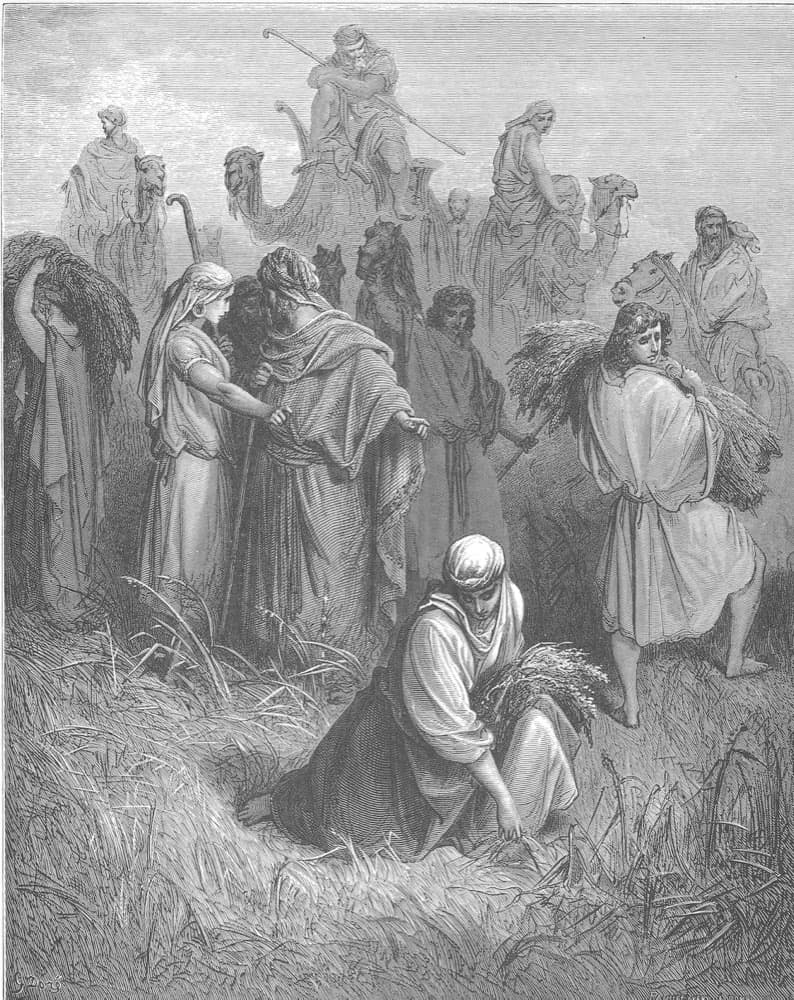
Ruth and Boaz
Week 42 of 52
study guideIsaiah 58–66
October 12–18, 2026
Isaiah 58 defines fasting entirely in terms of what is given away, and attaches every blessing in it to the giving rather than the abstaining.
The big idea
The Anointed One gives beauty for ashes — and the fast He chooses is the one that lifts someone else's burden.
Step 1 · Get your bearings
Before you read
Who is speaking, to whom, and what was happening to them.
- When
- Isaiah of Jerusalem, c. 740–700 BC, looking past the exile to the people who would return.
- Where
- Jerusalem restored — and, by the last chapters, a new heaven and a new earth.
- Who
- A community that had the forms of religion right — fasting, sabbath, sacrifice — and wondered why God did not seem to notice.
What was happening
Isaiah 58 opens with a complaint: “Wherefore have we fasted, say they, and thou seest not?” The last nine chapters answer it, and then widen into the largest vision in the Old Testament: Zion shining, the Anointed One proclaiming liberty, and a world without weeping.
Step 2 · See the whole
The shape of the week
Chapter 58 is a sermon on fasting that turns the practice inside out. The people went without food and still quarrelled and exploited their workers. God says the fast He chooses is to loosen chains, share bread and bring the homeless into your house — and He attaches every promise in the chapter to that.
Chapters 60–62 are a vision of Zion restored: “Arise, shine; for thy light is come.” At their centre, 61:1–3 describes someone anointed by the Spirit to bring good news to the poor and freedom to captives. Seven centuries later Jesus stood up in the synagogue at Nazareth, read it aloud, and said it was fulfilled that day.
Chapter 63 introduces a figure returning from Edom in blood-red garments, who has “trodden the winepress alone.” The Doctrine and Covenants applies the passage to the Second Coming. And the book ends where all of it has been heading — new heavens and a new earth, where the sound of weeping is no longer heard.
Step 3 · Read
Day by day
The block in seven readings, each with one thing to look for. Tick a day off when you have read it.
MonOct 12
List what Israel did when they fasted (verses 3–5) and what God asks instead (6–7). Then count the promises in 8–14.
TueOct 13
Verse 2 names what separates people from God. Verse 16 says who stepped in when no one else would.
FriOct 16
Who is the figure in red in 63:1–3, and what has he done alone? Then read verse 9 slowly.
SatOct 17
64:6 and 64:8 sit close together: filthy rags, and clay in a potter's hand. How do they fit?
Step 4 · Go slowly
Key passages
The verses the week turns on — what they meant to the people who first heard them, and what they mean for you. Tap any verse to mark it.
1Passage 1 of 5
The fast that I have chosen
Isaiah 58:6–9ot 6Is not this the fast that I have chosen? to loose the bands of wickedness, to undo the heavy burdens, and to let the oppressed go free, and that ye break every yoke?
7Is it not to deal thy bread to the hungry, and that thou bring the poor that are cast out to thy house? when thou seest the naked, that thou cover him; and that thou hide not thyself from thine own flesh?
8Then shall thy light break forth as the morning, and thine health shall spring forth speedily: and thy righteousness shall go before thee; the glory of the Lord shall be thy rearward.
9Then shalt thou call, and the Lord shall answer; thou shalt cry, and he shall say, Here I am. If thou take away from the midst of thee the yoke, the putting forth of the finger, and speaking vanity;
What it meant then
The people fasted to get God's attention while treating their workers harshly (58:3–4). God does not reject fasting; He redefines it. Going without is meant to free up something to give.
What it means now
The Church's fast offering is this chapter in practice: the cost of the meals not eaten goes to people who have none. The promises — light breaking forth, healing, the Lord answering — are attached to the giving, not to the going hungry.
In the original Hebrew
King James renders it “Here I am”
The answer Abraham, Moses, Samuel and Isaiah each gave when God called them (Genesis 22:1; Exodus 3:4; 1 Samuel 3:4; Isaiah 6:8). In 58:9 the direction is reversed: when you answer the needs of others, God says it to you.
Ask yourself
Whose burden could your next fast actually lighten?
2Passage 2 of 5
Arise, shine
Isaiah 60:1–3, 19–20ot 1Arise, shine; for thy light is come, and the glory of the Lord is risen upon thee.
2For, behold, the darkness shall cover the earth, and gross darkness the people: but the Lord shall arise upon thee, and his glory shall be seen upon thee.
3And the Gentiles shall come to thy light, and kings to the brightness of thy rising.
19The sun shall be no more thy light by day; neither for brightness shall the moon give light unto thee: but the Lord shall be unto thee an everlasting light, and thy God thy glory.
20Thy sun shall no more go down; neither shall thy moon withdraw itself: for the Lord shall be thine everlasting light, and the days of thy mourning shall be ended.
What it meant then
Zion is lying in darkness and told to get up — not because she has produced light, but because light has come upon her. Nations are drawn to it. By verse 19 the sun and moon are no longer needed: the Lord Himself is the light.
What it means now
The Lord used the same words to the Saints in 1838: “Arise and shine forth, that thy light may be a standard for the nations” (D&C 115:5). Zion's light is always borrowed light. We shine by reflecting, not by generating.
In the original Hebrew
King James renders it “Arise, shine”
The verb “shine” and the noun “thy light” in the next clause are the same root: “be light, for thy light has come.” Zion becomes light by receiving it.
Full lexicon entry →
Ask yourself
If the light is His, what does “shining” actually ask of you?
3Passage 3 of 5
Beauty for ashes
Isaiah 61:1–3ot 1The Spirit of the Lord God is upon me; because the Lord hath anointed me to preach good tidings unto the meek; he hath sent me to bind up the brokenhearted, to proclaim liberty to the captives, and the opening of the prison to them that are bound;
2To proclaim the acceptable year of the Lord, and the day of vengeance of our God; to comfort all that mourn;
3To appoint unto them that mourn in Zion, to give unto them beauty for ashes, the oil of joy for mourning, the garment of praise for the spirit of heaviness; that they might be called trees of righteousness, the planting of the Lord, that he might be glorified.
What it meant then
Someone anointed by the Spirit announces good news to the poor, healing for the brokenhearted and release for prisoners. “The acceptable year of the Lord” is the language of the Jubilee (Leviticus 25:10), the year when debts were cancelled and slaves went free.
What it means now
Jesus read this aloud at Nazareth and said, “This day is this scripture fulfilled in your ears” (Luke 4:21). He stopped in the middle of verse 2 — after “the acceptable year of the Lord,” before “the day of vengeance.” His first coming was the Jubilee. The vengeance waits.
In the original Hebrew
Ask yourself
Which exchange in verse 3 do you most need — beauty for ashes, joy for mourning, or praise for heaviness?
4Passage 4 of 5
He hath trodden the winepress alone
Isaiah 63:1–4, 9ot 1Who is this that cometh from Edom, with dyed garments from Bozrah? this that is glorious in his apparel, travelling in the greatness of his strength? I that speak in righteousness, mighty to save.
2Wherefore art thou red in thine apparel, and thy garments like him that treadeth in the winefat?
3I have trodden the winepress alone; and of the people there was none with me: for I will tread them in mine anger, and trample them in my fury; and their blood shall be sprinkled upon my garments, and I will stain all my raiment.
4For the day of vengeance is in mine heart, and the year of my redeemed is come.
9In all their affliction he was afflicted, and the angel of his presence saved them: in his love and in his pity he redeemed them; and he bare them, and carried them all the days of old.
What it meant then
A warrior strides in from Edom, Israel's old enemy, his garments stained red. He has defeated the nations by himself because no one else would help. Then, in verse 9, the tone softens completely: in all their affliction, He was afflicted.
What it means now
D&C 133:46–51 applies this to the Second Coming: the Lord will appear in red apparel. Latter-day Saints also hear the Atonement in it — He has “trodden the wine-press alone” (D&C 76:107), and Gethsemane is usually taken to mean “oil press.” Verse 9 may be the tenderest line in Isaiah.
Ask yourself
Verse 9 says He was afflicted in all of Israel's affliction. What would it change to believe that about yours?
5Passage 5 of 5
New heavens and a new earth
Isaiah 65:17–19, 25ot 17For, behold, I create new heavens and a new earth: and the former shall not be remembered, nor come into mind.
18But be ye glad and rejoice for ever in that which I create: for, behold, I create Jerusalem a rejoicing, and her people a joy.
19And I will rejoice in Jerusalem, and joy in my people: and the voice of weeping shall be no more heard in her, nor the voice of crying.
25The wolf and the lamb shall feed together, and the lion shall eat straw like the bullock: and dust shall be the serpent’s meat. They shall not hurt nor destroy in all my holy mountain, saith the Lord.
What it meant then
The book's last vision is of creation itself made new: Jerusalem a joy, no more weeping, the wolf and the lamb feeding together. For a people who had watched Jerusalem burn, this is not decoration. It is the answer.
What it means now
The tenth article of faith states the same hope: the earth will be renewed and receive its paradisiacal glory. John saw it too, and borrowed Isaiah's words: “God shall wipe away all tears from their eyes” (Revelation 21:1–4).
Ask yourself
What does verse 19 — no more weeping — tell you about what God intends for your sorrows?
Every page points to Him
Look for Christ
“They are they which testify of me” (John 5:39). Where this week's reading does.
The sermon at Nazareth
Jesus' first recorded sermon in Luke is Isaiah 61. He read it, sat down, and said it was fulfilled that day — a direct claim to be the Anointed One. The congregation's reaction went from wonder to trying to throw Him off a cliff in the space of a few verses.
The one in red apparel
Isaiah's warrior from Edom reappears in Revelation, “clothed with a vesture dipped in blood,” and in the Doctrine and Covenants, where the Lord says He has trodden the winepress alone. The same image holds both the Atonement and the Second Coming.
Isaiah 63:1–3 · Revelation 19:13–15 · D&C 76:107 · D&C 133:46–51
The light of the world
Isaiah 60:19 says the Lord will be Zion's everlasting light. Jesus said, “I am the light of the world,” and John's vision of the new Jerusalem has no sun, “the Lamb is the light thereof.”
Latter-day light
What the Restoration adds
What the Book of Mormon, the Doctrine and Covenants, the Pearl of Great Price and the Joseph Smith Translation bring to this block.
Fasting as rejoicing
The Lord told the Saints in 1831 that fasting and prayer is, “in other words, rejoicing and prayer.” The monthly fast and fast offering put Isaiah 58 into a routine: go without, give what you saved, and pray for someone.
Isaiah 63 in the Doctrine and Covenants
D&C 133 quotes Isaiah 63 almost word for word and places it at the Second Coming: the Lord will come in red apparel, and those who see Him will ask who He is.
What eye has not seen
Isaiah 64:4 — that no one has seen what God has prepared for those who wait for Him — is quoted by Paul and taken up in the vision of the degrees of glory, where the Lord promises to reveal to the faithful the wonders of eternity.
What to carry out of the week
Principles to live
- 1
The fast God accepts is measured by what it gives away.
- 2
When we answer others' needs, God answers ours.
“Thou shalt cry, and he shall say, Here I am” is promised to those who draw out their soul to the hungry.
- 3
Christ was anointed to heal the brokenhearted and set captives free.
- 4
He trod the winepress alone, and He is afflicted in our afflictions.
- 5
God intends a world without weeping.
- 6
The sabbath is meant to be a delight, not a burden.
Make it yours
Ponder and record
Pick one question. Write what comes — a sentence is enough.
- 01Israel asked, “Wherefore have we fasted… and thou seest not?” (58:3). Have you ever done something religious and felt unnoticed? What does 58:6–7 suggest?
- 0258:13 asks us to call the sabbath “a delight.” What would make your Sundays feel that way?
- 0364:6 calls our righteousness filthy rags; 64:8 calls us clay in God's hands. How do the two ideas fit together?
- 04Jesus stopped reading before “the day of vengeance.” What does that tell you about the purpose of His first coming?
- 05Which exchange in 61:3 do you most want in your own life right now?
Kept on this device, and collected in your notebook with everything else.
Teaching it
At home or in class
Simple ways to study this week together.
- Idea 1Plan your next fast together: choose a person or need to pray for, and talk about how a fast offering helps people nearby.
- Idea 2Turn off the lights, light one candle, and read 60:1–3. Talk about whose light we are reflecting.
- Idea 3Draw two columns — ashes and beauty, mourning and joy — from 61:3, and let everyone add an exchange they have seen the Lord make.
Keep going
More in this library
Full lessons, topics and word studies that bear on this week's block.
Doctrinal topics
The doctrine this block raises, followed wherever it goes in the canon.
Reference chains
Passages in a deliberate order, each step earning the next.
Hebrew & Greek
The words underneath the English, where the translation cost something.
Sources
- Come, Follow Me — For Home and Church: Old Testament 2026
- Old Testament Student Manual: 1 Kings–Malachi — Church Educational System, on Isaiah 58–66
- Gospel Topics, “Fasting and Fast Offerings”
- Brown, Driver and Briggs, A Hebrew and English Lexicon of the Old Testament — s.v. משׁח, פאר, אפר
Scripture text is the Church’s edition of the King James Version, fetched from the Gospel Library rather than retyped.