Come, Follow Me / 2026 / week 41
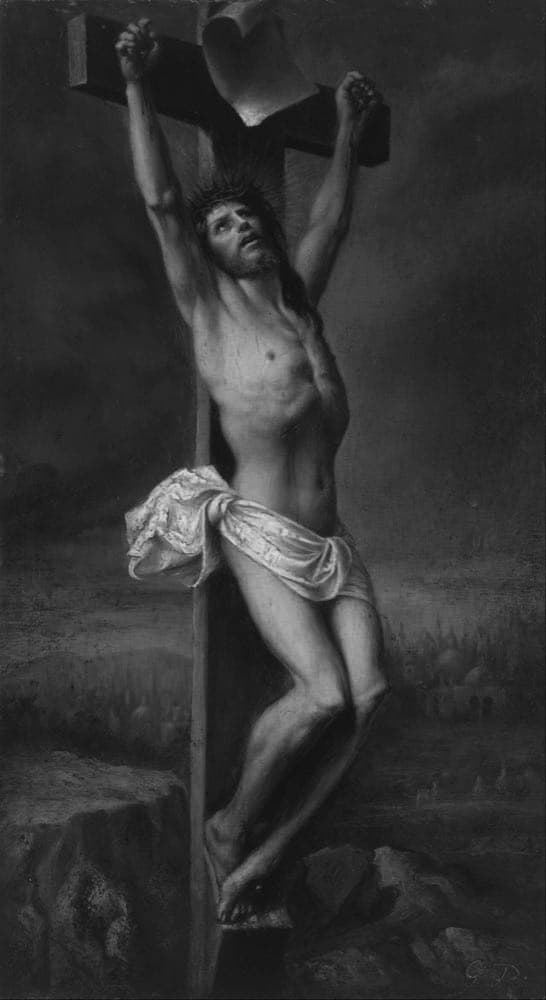
Christ on the Cross
Week 41 of 52
study guideIsaiah 50–57
October 5–11, 2026
The fourth Servant Song. Fifteen verses written seven centuries early, and the Hebrew is harder than the King James makes it.
The big idea
The Redeemer Isaiah promised would suffer for us willingly — and then offer everything He won without money and without price.
Step 1 · Get your bearings
Before you read
Who is speaking, to whom, and what was happening to them.
- When
- Isaiah of Jerusalem, c. 740–700 BC, speaking to a people who would go into exile c. 586–538 BC.
- Where
- Addressed to Jerusalem — pictured as a captive woman sitting in the dust, told to wake up and put on her strength.
- Who
- Exiles longing for release, and, through the Servant Songs, One who would suffer on their behalf.
What was happening
Chapter 40 promised comfort. These chapters say how it will be paid for. At their centre is the fourth Servant Song (52:13–53:12): fifteen verses describing a man despised, wounded and silent, whose suffering heals others.
Step 2 · See the whole
The shape of the week
This block moves from waking to feasting. Chapters 51–52 shout at Jerusalem to wake up and shake off her dust. Chapter 53 explains the price of her freedom. Chapters 54–55 throw open the doors: the barren woman sings, the tent is enlarged, and everyone who is thirsty is invited to come and eat for free.
Two Servant Songs fall in this week. The third (50:4–9) is spoken by the Servant himself — a disciple who listens each morning and who will not turn away from those who strike him. The fourth (52:13–53:12) is spoken about him, by people who realise too late that the one they despised was carrying their sorrows.
Isaiah 53 has its own full lesson in this library, verse by verse, with the Hebrew the King James softens. This guide gives the chapter its place in the week and points you there for the depth.
Step 3 · Read
Day by day
The block in seven readings, each with one thing to look for. Tick a day off when you have read it.
MonOct 5
In 50:4–7, who is speaking? Notice what he does every morning before anything else.
TueOct 6
Mark every command in verses 1–2. Then read D&C 113:7–10 for Joseph Smith's explanation.
ThuOct 8
The Savior quoted this whole chapter to the Nephites. Why might He have chosen it?
FriOct 9
Make two lists: what God offers in verses 1–3, and what He says about His ways in 8–11.
SatOct 10
Who is welcomed into the house of the Lord in verses 3–7 that the law of Moses had shut out?
Step 4 · Go slowly
Key passages
The verses the week turns on — what they meant to the people who first heard them, and what they mean for you. Tap any verse to mark it.
1Passage 1 of 5
The Servant who listens, and does not turn back
Isaiah 50:4–7ot 4The Lord God hath given me the tongue of the learned, that I should know how to speak a word in season to him that is weary: he wakeneth morning by morning, he wakeneth mine ear to hear as the learned.
5The Lord God hath opened mine ear, and I was not rebellious, neither turned away back.
6I gave my back to the smiters, and my cheeks to them that plucked off the hair: I hid not my face from shame and spitting.
7For the Lord God will help me; therefore shall I not be confounded: therefore have I set my face like a flint, and I know that I shall not be ashamed.
What it meant then
The third Servant Song is in the Servant's own voice. He is a learner before he is a teacher — wakened every morning to hear — and when the blows come, he does not run from them. His confidence is that the Lord will help him.
What it means now
Every detail is fulfilled in the Passion: He was struck and spat upon (Matthew 26:67; 27:30). “I set my face like a flint” is echoed in Luke 9:51, where Jesus “steadfastly set his face to go to Jerusalem,” knowing what waited there.
In the original Hebrew
King James renders it “the tongue of the learned”
Limmûdîm are not scholars but disciples — people who have been taught. The Servant can speak well because he has first listened well; the same word ends the verse, “to hear as the learned.”
Ask yourself
The Servant was given words so he could “speak a word in season to him that is weary.” Who needs a word from you this week?
2Passage 2 of 5
How beautiful upon the mountains
Isaiah 52:7–10ot 7How beautiful upon the mountains are the feet of him that bringeth good tidings, that publisheth peace; that bringeth good tidings of good, that publisheth salvation; that saith unto Zion, Thy God reigneth!
8Thy watchmen shall lift up the voice; with the voice together shall they sing: for they shall see eye to eye, when the Lord shall bring again Zion.
9Break forth into joy, sing together, ye waste places of Jerusalem: for the Lord hath comforted his people, he hath redeemed Jerusalem.
10The Lord hath made bare his holy arm in the eyes of all the nations; and all the ends of the earth shall see the salvation of our God.
What it meant then
A runner appears on the hills above ruined Jerusalem with news: the exile is over, God reigns. The watchmen on the walls see him coming and start singing before he arrives.
What it means now
Abinadi was asked about this very verse by King Noah's priests, and answered that its fulfilment is the Lord Himself and those who publish His peace (Mosiah 12:20–24; 15:13–18). Paul applied it to missionaries (Romans 10:15). The feet are dusty and ordinary — and God calls them beautiful.
In the original Hebrew
King James renders it “him that bringeth good tidings”
From bāśar, to announce good news. When the Old Testament was translated into Greek, this family of words became euangelion — the word English renders “gospel.” Isaiah 52:7 is one of the places the New Testament's central word comes from.
Ask yourself
Why would Isaiah praise the feet — the tired, walking part — of the one bringing news?
3Passage 3 of 5
He hath borne our griefs
Isaiah 53:3–5ot 3He is despised and rejected of men; a man of sorrows, and acquainted with grief: and we hid as it were our faces from him; he was despised, and we esteemed him not.
4Surely he hath borne our griefs, and carried our sorrows: yet we did esteem him stricken, smitten of God, and afflicted.
5But he was wounded for our transgressions, he was bruised for our iniquities: the chastisement of our peace was upon him; and with his stripes we are healed.
What it meant then
The speakers are people who once despised the Servant and now realise what his suffering meant: it was theirs, carried by him. Every line turns on the contrast between “he” and “we.”
What it means now
Abinadi quotes the whole chapter to Noah's court (Mosiah 14) and the Ethiopian eunuch was reading it when Philip found him (Acts 8:32–35). The full lesson on this chapter walks through the Hebrew: the “griefs” are literally sicknesses, and “wounded” is closer to “pierced.”
Ask yourself
Read verses 4–5 aloud, changing “our” to “my” and “we” to “I.” What changes?
4Passage 4 of 5
My kindness shall not depart
Isaiah 54:7–10ot 7For a small moment have I forsaken thee; but with great mercies will I gather thee.
8In a little wrath I hid my face from thee for a moment; but with everlasting kindness will I have mercy on thee, saith the Lord thy Redeemer.
9For this is as the waters of Noah unto me: for as I have sworn that the waters of Noah should no more go over the earth; so have I sworn that I would not be wroth with thee, nor rebuke thee.
10For the mountains shall depart, and the hills be removed; but my kindness shall not depart from thee, neither shall the covenant of my peace be removed, saith the Lord that hath mercy on thee.
What it meant then
Israel is pictured as a wife who was abandoned for a moment and is now taken back for ever. God compares His oath to the one He swore to Noah: as surely as the flood will not return, His covenant love will not be withdrawn.
What it means now
When the risen Savior taught the Nephites, He quoted this entire chapter to them (3 Nephi 22) and then commanded, “search these things diligently; for great are the words of Isaiah” (3 Nephi 23:1). Of all the chapters He could have chosen, He chose this promise.
In the original Hebrew
King James renders it “my kindness”
Ḥesed is the loyalty that belongs inside a covenant — love that keeps its promises. It is paired here with “the covenant of my peace.” Mountains are the most permanent thing in the ancient world, and God says they will move before this does.
Full lexicon entry →
Ask yourself
Verse 7 names a “small moment” of feeling forsaken. How do you hold on during a moment like that?
5Passage 5 of 5
Come, buy without money
Isaiah 55:1–3, 8–9ot 1Ho, every one that thirsteth, come ye to the waters, and he that hath no money; come ye, buy, and eat; yea, come, buy wine and milk without money and without price.
2Wherefore do ye spend money for that which is not bread? and your labour for that which satisfieth not? hearken diligently unto me, and eat ye that which is good, and let your soul delight itself in fatness.
3Incline your ear, and come unto me: hear, and your soul shall live; and I will make an everlasting covenant with you, even the sure mercies of David.
8For my thoughts are not your thoughts, neither are your ways my ways, saith the Lord.
9For as the heavens are higher than the earth, so are my ways higher than your ways, and my thoughts than your thoughts.
What it meant then
The invitation of a street vendor, turned inside out: come and buy — but bring no money. After the price is paid in chapter 53, what it bought is given away.
What it means now
Jacob quotes these words in 2 Nephi 9:50–51, and Jesus echoes them in John 7:37: “If any man thirst, let him come unto me, and drink.” Verses 8–9 are not a rebuke but a reassurance — God's mercy is larger than ours, not merely different.
Ask yourself
Verse 2 asks why we spend money “for that which is not bread.” What do you spend time or money on that never satisfies?
Every page points to Him
Look for Christ
“They are they which testify of me” (John 5:39). Where this week's reading does.
The Servant's face set like a flint
The third Servant Song describes a man who gives his back to the smiters and does not hide from spitting. The Gospels record exactly that, and Luke uses Isaiah's image when Jesus turns toward Jerusalem knowing what waits there.
Isaiah 50:6–7 · Matthew 26:67 · Matthew 27:26–30 · Luke 9:51
Isaiah 53 in three witnesses
Abinadi quotes it and explains who the Servant's “seed” are. Philip preaches Jesus from it to the Ethiopian. Peter quotes it in his first epistle: “by whose stripes ye were healed.” Three independent witnesses read the chapter the same way.
A house of prayer for all people
When Jesus cleansed the temple He quoted Isaiah 56:7. The chapter it comes from is about opening God's house to foreigners and eunuchs whom the law had excluded — which is exactly what He was defending.
Latter-day light
What the Restoration adds
What the Book of Mormon, the Doctrine and Covenants, the Pearl of Great Price and the Joseph Smith Translation bring to this block.
“Awake, awake; put on thy strength”
Joseph Smith was asked what Isaiah 52:1–2 meant. The answer, recorded in D&C 113, is that putting on strength means putting on the authority of the priesthood, and loosing the bands from Zion's neck means scattered Israel returning to the Lord.
Where the word “stake” comes from
Isaiah 54:2 tells Zion to enlarge her tent, lengthen her cords and strengthen her stakes. The Lord took up the image in 1832 — “her stakes must be strengthened” — and it became the name for the Church's regional units. Each stake is a peg holding the tent of Zion down.
The chapter the Savior chose
The risen Christ quoted Isaiah 54 to the Nephites in full, then said, “great are the words of Isaiah.” It is one of only a few Old Testament chapters He is recorded reciting in its entirety.
What to carry out of the week
Principles to live
- 1
The Savior suffered willingly, and set His face toward it.
- 2
The good news is carried by people, and God calls their feet beautiful.
- 3
God's covenant love outlasts mountains.
- 4
Salvation is offered without money and without price.
Nephi echoes Isaiah directly: no one is told to depart, none are forbidden, and all are invited to buy “without money and without price.”
- 5
God's ways are higher than ours, and His word does not return empty.
Make it yours
Ponder and record
Pick one question. Write what comes — a sentence is enough.
- 01The Servant listened every morning before he spoke (50:4). What does your morning look like before you face the day?
- 02Why do you think the risen Savior chose Isaiah 54, of all chapters, to recite to the Nephites?
- 03Isaiah 53:6 says “all we like sheep have gone astray.” Is it easier for you to believe that about others or about yourself?
- 04What is something you have tried to earn that 55:1 says is already free?
- 05Isaiah 57:15 says God lives in two places — on high, and with the contrite. What does it mean to you that He chooses the second?
Kept on this device, and collected in your notebook with everything else.
Teaching it
At home or in class
Simple ways to study this week together.
- Idea 1Look at everyone's shoes and read 52:7. Talk about places your feet have carried good news — or could this week.
- Idea 2Build a blanket tent and read 54:2. Talk about why the Church calls its local units “stakes,” and what a stake does for a tent.
- Idea 3Offer everyone a free drink or snack and read 55:1. What does the Lord offer that no one could ever buy?
Keep going
More in this library
Full lessons, topics and word studies that bear on this week's block.
Lessons
Full studies on this block — setting, original language, doctrine, sources.
Doctrinal topics
The doctrine this block raises, followed wherever it goes in the canon.
Reference chains
Passages in a deliberate order, each step earning the next.
Diagrams & maps
Drawn for this library — worth a minute even when the prose was clear.
Hebrew & Greek
The words underneath the English, where the translation cost something.
Sources
- Come, Follow Me — For Home and Church: Old Testament 2026
- Old Testament Student Manual: 1 Kings–Malachi — Church Educational System, on Isaiah 50–57
- Doctrine and Covenants 113 — Answers to questions on Isaiah 11 and 52
- Brown, Driver and Briggs, A Hebrew and English Lexicon of the Old Testament — s.v. למד, בשר, חסד
Scripture text is the Church’s edition of the King James Version, fetched from the Gospel Library rather than retyped.