Come, Follow Me / 2026 / week 52
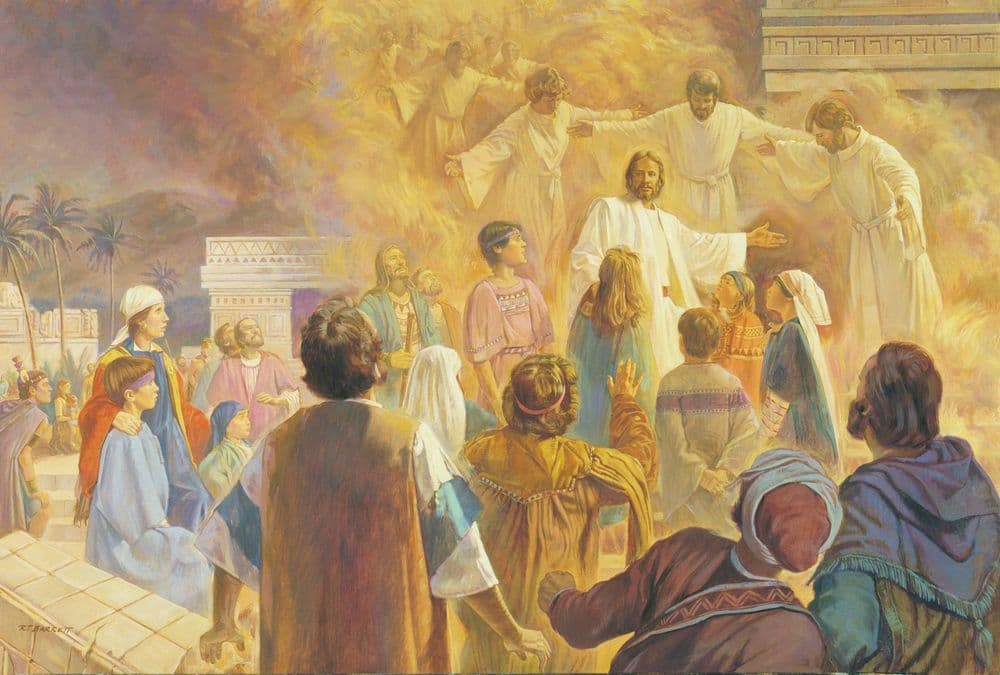
Jesus Blesses the Nephite Children · 3 Ne. 17:11–25
Week 52 of 52
study guideChristmasChristmas
December 21–27, 2026
The year ends where the prophets were pointing. The condescension of God, and every name the canon gives Him.
The big idea
For seven centuries, prophets on two continents saw the same birth coming — and every one of them was pointing to the same Child.
Step 1 · Get your bearings
Before you read
Who is speaking, to whom, and what was happening to them.
- When
- Prophecies from Isaiah (c. 740 BC) to Samuel the Lamanite (c. 6 BC), and the birth itself around the turn of the eras.
- Where
- Bethlehem of Judea — and, in the Book of Mormon, a land where one night never grew dark.
- Who
- Isaiah, Micah, Nephi, King Benjamin and Samuel the Lamanite; Mary and Joseph; shepherds and wise men; believers in Zarahemla waiting for a sign.
What was happening
A year in the Old Testament ends where its prophets were pointing. This week gathers the prophecies of Christ's birth from the Old Testament and the Book of Mormon and reads each beside its fulfilment. The Church's Come, Follow Me manual has its own Christmas lesson; this is a companion to it.
Step 2 · See the whole
The shape of the week
The Old Testament is full of promises that lean forward: a young woman's son named Immanuel, God with us (Isaiah 7:14); a child with five names on David's throne (Isaiah 9:6–7); a shoot growing out of the stump of Jesse (Isaiah 11:1); a ruler from little Bethlehem whose origins are from everlasting (Micah 5:2).
The Book of Mormon adds witnesses the Bible does not have. Nephi saw Mary and the Child in vision six centuries early (1 Nephi 11). King Benjamin's angel named both Jesus and Mary more than a century before the birth (Mosiah 3:8). Samuel the Lamanite promised a day, a night and a day without darkness, and a new star (Helaman 14). And on the eve of the birth, believers facing execution heard the Lord Himself: “on the morrow come I into the world” (3 Nephi 1:13).
An honest note on Isaiah 7:14. The Hebrew word ʿalmāh means a young woman of marriageable age; it was the Greek translation of the Old Testament that rendered it “virgin,” and Matthew quotes the Greek. Latter-day Saints have an independent witness in Nephi, who saw “a virgin, most beautiful and fair above all other virgins,” and then saw her holding the Son of God (1 Nephi 11:13–20).
Step 3 · Read
Day by day
The block in seven readings, each with one thing to look for. Tick a day off when you have read it.
MonDec 21
Read the five names in 9:6 slowly. Which do you most need Him to be this Christmas?
TueDec 22
What grows out of a stump in 11:1? Which town is named in Micah 5:2, and why is it surprising?
WedDec 23
What did Nephi see six hundred years early? Look for the word “condescension.”
ThuDec 24
What signs did Samuel promise, and what were they meant to do (verses 11–13)?
FriDec 25
What were the believers facing (verse 9)? What did the Lord say to Nephi (verse 13)?
SatDec 26
Find every place Matthew connects an event to something the prophets said.
SunDec 27
What did the angels announce? What did the shepherds do afterwards (verses 17–20)?
Step 4 · Go slowly
Key passages
The verses the week turns on — what they meant to the people who first heard them, and what they mean for you. Tap any verse to mark it.
1Passage 1 of 6
Unto us a child is born
Isaiah 9:6–7ot 6For unto us a child is born, unto us a son is given: and the government shall be upon his shoulder: and his name shall be called Wonderful, Counsellor, The mighty God, The everlasting Father, The Prince of Peace.
7Of the increase of his government and peace there shall be no end, upon the throne of David, and upon his kingdom, to order it, and to establish it with judgment and with justice from henceforth even for ever. The zeal of the Lord of hosts will perform this.
What it meant then
Written in a dark time for Judah, with Assyria overrunning the north, it promises a child who will sit on David's throne and whose government will have no end. He is given five names.
What it means now
Handel set these words in Messiah, and they sit at the heart of Christmas. Each name describes something He does: counsels wonderfully, is mighty God, is a father who does not leave, and brings peace that has no end.
In the original Hebrew
King James renders it “The Prince of Peace”
Šālôm is more than the absence of conflict. It means wholeness — everything as it should be, nothing missing and nothing broken. The Prince of Peace is the one who makes people and things whole.
Full lexicon entry →
Ask yourself
Which of the five names do you most need Him to be for you this Christmas?
2Passage 2 of 6
Immanuel — God with us
Isaiah 7:14ot 14Therefore the Lord himself shall give you a sign; Behold, a virgin shall conceive, and bear a son, and shall call his name Immanuel.
What it meant then
King Ahaz, terrified of two invading armies, refused to ask God for a sign. Isaiah gave him one anyway: a young woman would bear a son and name him Immanuel.
What it means now
Matthew quotes the verse of Mary and her Son (Matthew 1:22–23). The name is the whole message of Christmas in two Hebrew words: God is with us.
In the original Hebrew
King James renders it “a virgin”
ʿAlmāh means a young woman of marriageable age. The Greek Old Testament translated it parthenos, “virgin,” and Matthew quotes that translation. This is worth knowing plainly. Nephi's vision of Mary as a virgin (1 Nephi 11:13–20) is an independent witness that does not depend on the translation.
Ask yourself
What does the name Immanuel mean for the hardest part of your life right now?
3Passage 3 of 6
Knowest thou the condescension of God?
1 Nephi 11:13–21bofm 13And it came to pass that I looked and beheld the great city of Jerusalem, and also other cities. And I beheld the city of Nazareth; and in the city of Nazareth I beheld a virgin, and she was exceedingly fair and white.
14And it came to pass that I saw the heavens open; and an angel came down and stood before me; and he said unto me: Nephi, what beholdest thou?
15And I said unto him: A virgin, most beautiful and fair above all other virgins.
16And he said unto me: Knowest thou the condescension of God?
17And I said unto him: I know that he loveth his children; nevertheless, I do not know the meaning of all things.
18And he said unto me: Behold, the virgin whom thou seest is the mother of the Son of God, after the manner of the flesh.
19And it came to pass that I beheld that she was carried away in the Spirit; and after she had been carried away in the Spirit for the space of a time the angel spake unto me, saying: Look!
20And I looked and beheld the virgin again, bearing a child in her arms.
21And the angel said unto me: Behold the Lamb of God, yea, even the Son of the Eternal Father! Knowest thou the meaning of the tree which thy father saw?
What it meant then
Nephi asked to understand his father's dream of the tree of life. The angel's answer was a question — did he know the condescension of God? — and then a vision: a virgin in Nazareth, and then the Child in her arms. “Behold the Lamb of God.”
What it means now
Asked what the love of God is, heaven's answer was a baby. The word condescension means God coming down to us — the subject of this library's lesson on the condescension of God.
Ask yourself
Nephi said, “I know that he loveth his children; nevertheless, I do not know the meaning of all things” (11:17). How is that a model for your own faith?
4Passage 4 of 6
A day and a night and a day
Helaman 14:2–6bofm 2And behold, he said unto them: Behold, I give unto you a sign; for five years more cometh, and behold, then cometh the Son of God to redeem all those who shall believe on his name.
3And behold, this will I give unto you for a sign at the time of his coming; for behold, there shall be great lights in heaven, insomuch that in the night before he cometh there shall be no darkness, insomuch that it shall appear unto man as if it was day.
4Therefore, there shall be one day and a night and a day, as if it were one day and there were no night; and this shall be unto you for a sign; for ye shall know of the rising of the sun and also of its setting; therefore they shall know of a surety that there shall be two days and a night; nevertheless the night shall not be darkened; and it shall be the night before he is born.
5And behold, there shall a new star arise, such an one as ye never have beheld; and this also shall be a sign unto you.
6And behold this is not all, there shall be many signs and wonders in heaven.
What it meant then
Five years before the birth, a Lamanite prophet stood on the wall of Zarahemla while the people tried to shoot him down, and gave signs of the coming birth: a night with no darkness and a new star.
What it means now
Samuel said the signs were given so that people could know of the Savior's coming and believe on His name (14:11–13). The Book of Mormon records that the sign came exactly as promised (3 Nephi 1:15–21).
Ask yourself
What signs — large or small — have helped you believe in Christ?
5Passage 5 of 6
On the morrow come I into the world
3 Nephi 1:12–15bofm 12And it came to pass that he cried mightily unto the Lord all that day; and behold, the voice of the Lord came unto him, saying:
13Lift up your head and be of good cheer; for behold, the time is at hand, and on this night shall the sign be given, and on the morrow come I into the world, to show unto the world that I will fulfil all that which I have caused to be spoken by the mouth of my holy prophets.
14Behold, I come unto my own, to fulfil all things which I have made known unto the children of men from the foundation of the world, and to do the will, both of the Father and of the Son—of the Father because of me, and of the Son because of my flesh. And behold, the time is at hand, and this night shall the sign be given.
15And it came to pass that the words which came unto Nephi were fulfilled, according as they had been spoken; for behold, at the going down of the sun there was no darkness; and the people began to be astonished because there was no darkness when the night came.
What it meant then
Unbelievers set a day on which every believer would be killed unless the sign came. Nephi prayed all that day, and the voice of the Lord answered: be of good cheer — tonight the sign will be given, and tomorrow I come into the world.
What it means now
It is the only record in scripture of the Lord speaking on the eve of His own birth. At sunset, the darkness never came.
Ask yourself
Nephi prayed “all that day” (1:12). What are you praying about with that kind of intensity?
6Passage 6 of 6
Good tidings of great joy
Luke 2:8–14nt 8And there were in the same country shepherds abiding in the field, keeping watch over their flock by night.
9And, lo, the angel of the Lord came upon them, and the glory of the Lord shone round about them: and they were sore afraid.
10And the angel said unto them, Fear not: for, behold, I bring you good tidings of great joy, which shall be to all people.
11For unto you is born this day in the city of David a Saviour, which is Christ the Lord.
12And this shall be a sign unto you; Ye shall find the babe wrapped in swaddling clothes, lying in a manger.
13And suddenly there was with the angel a multitude of the heavenly host praising God, and saying,
14Glory to God in the highest, and on earth peace, good will toward men.
What it meant then
The announcement went first to shepherds on a night watch — ordinary working men, not priests or kings. The sign they were given was a baby in a feeding trough.
What it means now
The good news is “to all people.” The shepherds' response is still the pattern: they went to see, and then they told everyone they met (2:15–17).
Ask yourself
Why do you think God announced the birth first to shepherds?
Every page points to Him
Look for Christ
“They are they which testify of me” (John 5:39). Where this week's reading does.
God with us
Isaiah's Immanuel is Matthew's first title for Jesus, and Matthew's Gospel ends with the same promise in His own voice: “lo, I am with you alway.” The whole Gospel sits between the two.
The Lord Omnipotent in a tabernacle of clay
More than a century before the birth, King Benjamin's angel described the Lord Omnipotent coming down from heaven to dwell in a body, and named Him — Jesus Christ — and His mother, Mary.
The Word made flesh
John's Christmas story has no manger and no shepherds — only this: the Word, who was with God and was God, became flesh and lived among us, and we saw His glory.
Latter-day light
What the Restoration adds
What the Book of Mormon, the Doctrine and Covenants, the Pearl of Great Price and the Joseph Smith Translation bring to this block.
Two continents, one birth
The Book of Mormon records the sign of the birth as seen in the Americas, and the conversion of many who saw it. The Bible tells of a star seen from the east; the Book of Mormon, of a night without darkness in the west.
Named before He was born
King Benjamin named Jesus and Mary around 124 BC. Alma, a few decades later, said He would be born of Mary “at Jerusalem” — the land around Jerusalem, as Bethlehem lies a few miles from the city.
Counting from His birth
The revelation organising the Church in 1830 dates the event by the Savior's birth: 1,830 years since His coming in the flesh.
What to carry out of the week
Principles to live
- 1
God fulfils His promises, even across centuries.
Isaiah 9:6–7 · Helaman 14:2–6 · 3 Nephi 1:13–15 · D&C 1:37–38
- 2
The birth of Christ is the condescension of God — His love made visible.
- 3
Christ is Immanuel: God with us.
- 4
The Lord sustains believers who wait on His promises.
- 5
The good tidings are for all people.
- 6
Finding Christ leads to telling others.
Make it yours
Ponder and record
Pick one question. Write what comes — a sentence is enough.
- 01Which prophecy of Christ's birth means the most to you, and why?
- 02The believers in 3 Nephi 1 faced death if the sign did not come. What promises are you waiting on in faith?
- 03Why do you think God announced the birth first to shepherds, and made its sign a baby in a manger?
- 04How might you “make known abroad” (Luke 2:17) what you know about Christ this Christmas?
- 05Looking back over this year in the Old Testament, where did you see Christ most clearly?
Kept on this device, and collected in your notebook with everything else.
Teaching it
At home or in class
Simple ways to study this week together.
- Idea 1Read one prophecy each evening this week alongside its fulfilment, following the day plan above.
- Idea 2On Christmas Eve, read 3 Nephi 1:15–19 by a single light, and talk about a night with no darkness.
- Idea 3Write the five names from Isaiah 9:6 on ornaments or cards, and let each person say what one of them means to them.
Keep going
More in this library
Full lessons, topics and word studies that bear on this week's block.
Lessons
Full studies on this block — setting, original language, doctrine, sources.
Doctrinal topics
The doctrine this block raises, followed wherever it goes in the canon.
Reference chains
Passages in a deliberate order, each step earning the next.
Hebrew & Greek
The words underneath the English, where the translation cost something.
Sources
- Come, Follow Me — For Home and Church: Old Testament 2026 — Including the manual's own Christmas lesson
- Bible Dictionary, “Immanuel”
- Brown, Driver and Briggs, A Hebrew and English Lexicon of the Old Testament — s.v. עלמה, שׁלום
Scripture text is the Church’s edition of the King James Version, fetched from the Gospel Library rather than retyped.