Library / Doctrine and Covenants
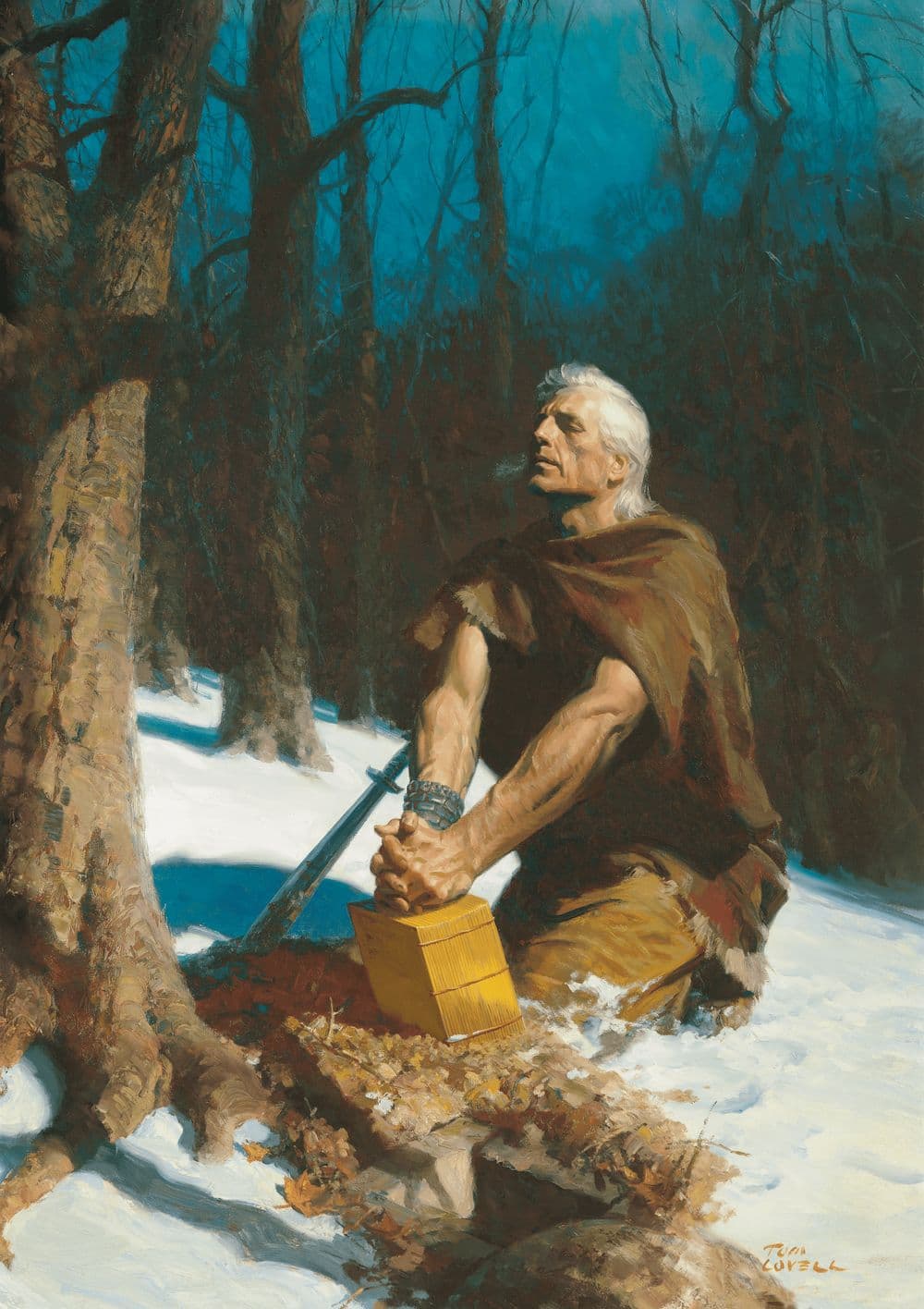
Moroni Hides the Plates in the Hill Cumorah · Morm. 6:6
Doctrine and Covenants
The Redemption of the Dead
D&C 138, and what Christ did between Friday and Sunday
D&C 138; 1 Peter 3:18–20; 1 Peter 4:6; Alma 40:11–1440 min4 sections
An old man, six months from his own death and having buried a son that year, reads three verses in 1 Peter over and over and is shown what happens in the spirit world. It answers the oldest objection to Christianity — what about everyone who never heard — with an organisation chart.
- Author
- Joseph F. Smith, sixth President of the Church
- Date
- 3 October 1918; canonised in 1976 and added to the Doctrine and Covenants in 1979
- Place
- Salt Lake City
- Audience
- The Church, in the last months of the First World War and during the influenza pandemic
- Genre
- Vision, recorded the same day
By the end you should be able to
- Describe the circumstances in which the vision was received.
- Explain what the vision says Christ did and did not do in the spirit world.
- State how the gospel reaches those who died without it.
- Say what the vision adds to 1 Peter 3:18–20 that the biblical text leaves ambiguous.
The man and the year
Context that is usually skipped and should not be.
By October 1918 Joseph F. Smith was eighty and had less than six weeks to live. His eldest son Hyrum Mack Smith, an apostle, had died suddenly in January at forty-five. The First World War was in its final months; the influenza pandemic was killing people by the million. He had been too ill to attend the conference at which the vision was read.
1On the third of October, in the year nineteen hundred and eighteen, I sat in my room pondering over the scriptures;
2And reflecting upon the great atoning sacrifice that was made by the Son of God, for the redemption of the world;
6I opened the Bible and read the third and fourth chapters of the first epistle of Peter, and as I read I was greatly impressed, more than I had ever been before, with the following passages:
11As I pondered over these things which are written, the eyes of my understanding were opened, and the Spirit of the Lord rested upon me, and I saw the hosts of the dead, both small and great.
Principle
The vision came to a man reading a difficult passage repeatedly, in grief, with a question he could not put down.
The pattern is the same as D&C 76, which came while Joseph Smith and Sidney Rigdon were revising John 5:29, and the same as JS—H 1:11, which came out of James 1:5. Revelation in this tradition tends to arrive as an answer to careful reading rather than instead of it.
What the vision corrects
The surprise is in verses 20–22 and 29–30.
20But unto the wicked he did not go, and among the ungodly and the unrepentant who had defiled themselves while in the flesh, his voice was not raised;
21Neither did the rebellious who rejected the testimonies and the warnings of the ancient prophets behold his presence, nor look upon his face.
22Where these were, darkness reigned, but among the righteous there was peace;
29And as I wondered, my eyes were opened, and my understanding quickened, and I perceived that the Lord went not in person among the wicked and the disobedient who had rejected the truth, to teach them;
30But behold, from among the righteous, he organized his forces and appointed messengers, clothed with power and authority, and commissioned them to go forth and carry the light of the gospel to them that were in darkness, even to all the spirits of men…
The traditional reading of 1 Peter 3:19 has Christ personally preaching to the spirits in prison. Joseph F. Smith reports that this is not what happened, and the correction is the vision's central contribution: Christ did not go among them Himself. He organised and commissioned others.
The spirit world sits between death and resurrection in the plan — a stage, not a destination.
Who is there
A guest list that tells you what the vision is arguing.
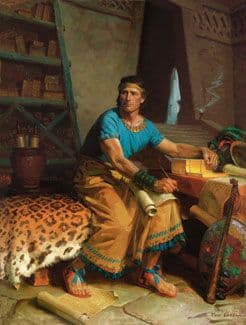
Mormon at the plates. D&C 138 places him among those Joseph F. Smith saw. · W of M 1:1–11
- Adam, and Eve “with many of her faithful daughters who had lived through the ages” (v. 38–39) — named, and named together.
- Abel, Seth, Noah, Abraham, Isaac, Jacob, Moses, Isaiah, Ezekiel, Daniel, Elias, Malachi (v. 40–46).
- Elijah, and the prophets who dwelt among the Nephites (v. 46, 49).
- Joseph Smith, Hyrum Smith, Brigham Young, John Taylor, Wilford Woodruff (v. 53).
- “Other choice spirits who were reserved to come forth in the fulness of times” (v. 53–56).
58The dead who repent will be redeemed, through obedience to the ordinances of the house of God,
59And after they have paid the penalty of their transgressions, and are washed clean, shall receive a reward according to their works, for they are heirs of salvation.
Verse 58 is the hinge between this vision and the temple. The dead can repent and be taught, but ordinances are physical and they have no bodies — so someone living has to stand in for them. The doctrine and the practice arrive together.
Cross-references
- 1 Peter 4:6'For this cause was the gospel preached also to them that are dead' — the verse that makes the whole doctrine biblical rather than novel.
- Alma 40:11–14Alma's account of paradise and prison, given centuries earlier.
- 1 Corinthians 15:29Baptism for the dead, mentioned by Paul in passing as something his readers already did.
- D&C 128:15–18'They without us cannot be made perfect, neither can we without our dead.'
- D&C 137:7–9The 1836 vision: those who would have received the gospel are heirs of the celestial kingdom, and God judges by the desire of the heart.
The objection it answers
What about everyone who never heard.
It is the oldest objection to exclusive Christian claims, and most traditions answer it in one of three ways: the unevangelised are lost; or the requirement is quietly relaxed; or the question is left to God's mercy without a mechanism. The Restoration answers with a mechanism.
| The problem | The answer in D&C 138 |
|---|---|
| Most of humanity died without hearing the gospel | They are taught in the spirit world, by messengers commissioned for it |
| Ordinances are required, and the dead cannot perform them | The living perform them by proxy, in temples |
| Proxy work could be an imposition | The dead retain agency and may accept or refuse — v. 31–34, 58 |
| The work is impossibly large | It is, by design, not completable in one lifetime |
Principle
Nobody is condemned for not hearing, and nobody is compelled for having been offered — which is what makes the doctrine both universal and voluntary.
To consider
- 01The vision came to a grieving man reading the same three verses over again. What are you reading that way?
- 02Christ organised messengers rather than going Himself. What does that suggest about how the work you are asked to do is distributed?
- 03The work is designed not to be finished in a lifetime. What kind of patience does that ask for?
What this lesson holds
Christ organised and commissioned messengers in the spirit world rather than preaching to the wicked in person.
The dead can repent, be taught, and receive ordinances performed by proxy — and may refuse them.
Missionary work and temple work are two halves of one operation, on both sides of the veil.
Check your reading
5 questions01What was Joseph F. Smith reading when the vision came?
02What does the vision correct about 1 Peter 3:19?
03Who does verse 39 name alongside Adam?
04Why must the living perform ordinances for the dead?
05How does the doctrine avoid being an imposition on the dead?
Where to go next
Sources
- D&C 138 — The primary text.
- Revelations in Context, "The Vision of the Redemption of the Dead"
- Gospel Topics, "Spirit World"